Recap of the 2nd NSC workshop on “SSbD scenarios” on 5 December 2025
Following up from the 1st NSC workshop on “SSbD scenarios for advanced and incremental innovations” (23 June 2025), the NSC Working Group on Safe and Sustainable by Design (SSbD), Innovation & Regulation organised a virtual 2nd NSC workshop on SSbD Scenarios on 5th December 2025. Similarly as the first workshop, this second one was prepared as a collaborative effort among several EU-funded projects: DESIDERATA, PLANETS, SSbD4CheM, and SUNRISE.
The 1st NSC scenarios workshop laid the basis by the description of a scenario by aspects of novelty, exposure, severity, (environmental) sustainability, (economic) scope and immediacy. Case studies enabled a refinement of the scenario description (Wohlleben et al. 2025). The concept of a scenario was integrated by JRC into the revised SSbD Framework, where it serves as a bridge between the SSbD scoping and a tailored safety and sustainability assessment (reproduced in lower figure). It was described as “a specific and real set of conditions (scoping analysis elements) that define the context in which the SSbD assessment is carried out.”(Garmendia Aguirre et al. 2025).
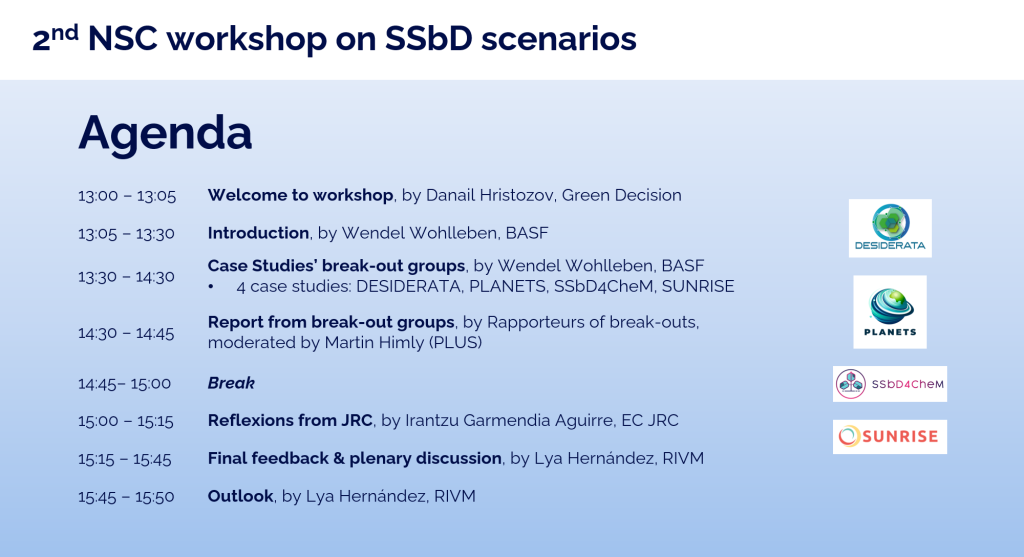
This 2nd NSC scenarios workshop explored how to describe an SSbD scenario, the tailoring rules related, as well as how to select which tailored approach fits best a specific innovation case. Examples of real-world cases were provided by innovators from the projects DESIDERATA, PLANETS, SSbD4CheM, and SUNRISE. In breakout sessions moderated teams went through the respective cases to define the SSbD maturity, pull and push, expected commercial value, probability of success (technical and commercial) and ultimately the return on investment that additional SSbD would expect. Obtained results were compared to six proposedly archetypal SSbD scenarios. This business-focussed algorithm enables defining a tailored SSbD in a more straight-forward manner. Such an approach, based on specifications collected during scoping, could argue for more or less extensive SSbD assessment to be implemented for different innovation cases, providing arguments for innovators in their discussion with management.
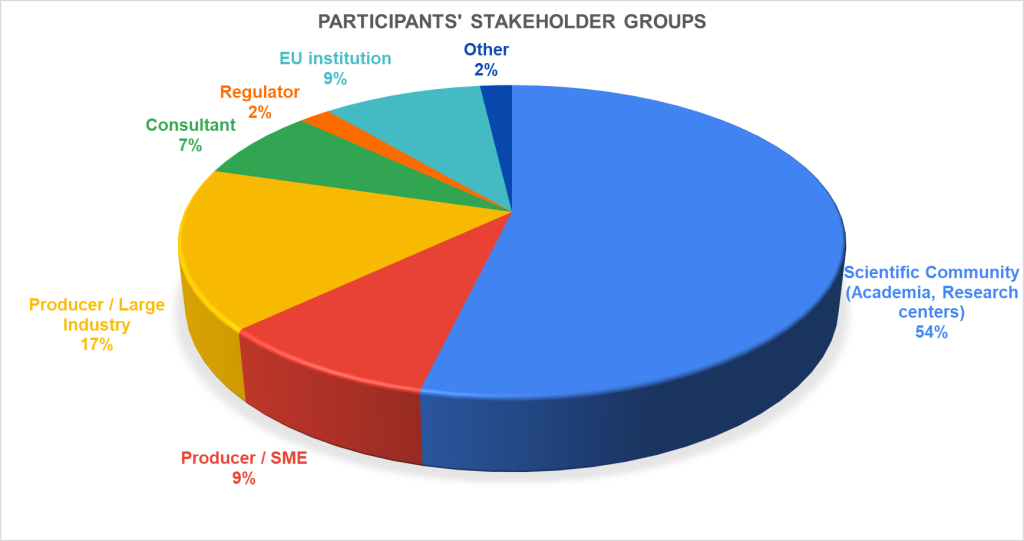
Danail Hristozov (GreenDecision, and chair of the NSC WG on SSbD) opened the workshop and welcomed the more than 50 international participants from academia (54%), large industry (17%), SME (9%), consultants (7%), regulators (2%) and EU institutions (9%).
Wendel Wohlleben (BAuA, formerly BASF, and co-chair of the NSC WG on SSbD) presented how to tailor the SSbD implementation by using the scenarios. He explained how the most relevant aspects describing the scenario were selected after the 1st workshop, and how the newly developed spreadsheet “SSbD-ified ECV calculator” estimates the impact of implementing SSbD into an innovation project plan. The standardised business metric of the “Expected Commercial Value (ECV)” was used as the basis for the tool, which had been made available to all workshop participants, and feedback was gathered during the break-out groups.
Workshop participants split up into the break-out groups, where the tailoring and other aspects in the different innovation case were explored and discussed:
- DESIDERATA case study: Olga Thoda, from MONOLITHOS, on geopolymers originating from mining waste as replacement of Aluminum in construction, moderated by Lya Hernandez, RIVM.
- PLANETS case study: Tobias Moss, from Budenheim, on flame retardants in construction, moderated by Carla Caldeira, SYENSQO.
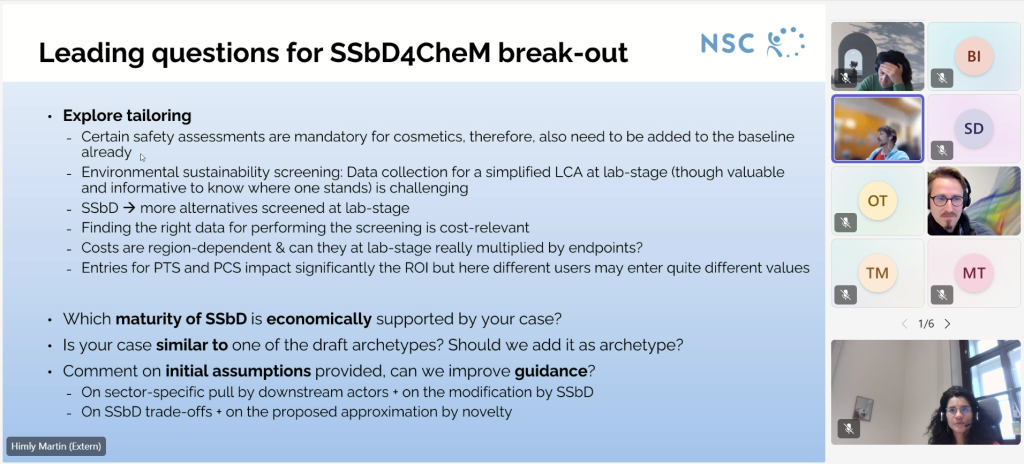
- SSbD4CheM case study: Ondej Panak, from the Slovenian National Institute of Chemistry, on cosmetics (assisted by Assaf Assis, David Barak, and Dror Cohen, from AHAVA Dead Sea Laboratories, moderated by Martin Himly, PLUS.
- SUNRISE case study: María José López Tendero, from Laurentia Technologies, on post-harvest fruit treatment based on safer microencapsulated oil, moderated by Danail Hristozov, GreenDecision.
Martin Himly (PLUS and chair of the NSC WG on ETC) moderated the joint reporting session of the different breakouts, where the discussions in each of the groups were briefly summarised and discussed in the plenary.
Irantzu Garmendia Aguirre from the European Commission’s Joint Research Centre (JRC) contributed key insights to the workshop, sharing the JRC’s perspectives on the current adaptations within the SSbD framework. Her intervention addressed the core SSbD principles, the scoping analysis, and the development of SSbD scenarios, highlighting their relevance for advancing safe and sustainable innovation.
The workshop ended with a final round of feedback and plenary discussion, moderated by Lya Hernández (RIVM), where workshop participants dived into vivid discussions, which will be picked up in the 3rd NSC scenarios workshop anticipated for late spring 2026.
Two main activities are planned as follow-ups of this 2nd workshop: A third workshop (planned for 2026) to discuss the process from archetypal scenarios to tiered SSbD assessment, and a joint peer-reviewed NSC publication about the tailored SSbD approaches followed by the different case studies presented in the workshop.
Workshop materials:
Workshop materials are publicly available in Zenodo, under DOI: 10.5281/zenodo.19554509.
The recording of the workshop is available in the NSC YouTube channel.
References:
- Garmendia Aguirre, I., E. Abbate, G. Bracalente, L. Mancini, G. Cappucci, D. Tosches, K. Rasmussen, B. Sokull-Klüttgen, H. Rauscher and S. Sala (2025). “Safe and Sustainable by Design Chemicals and Materials. Revised framework”. Draft for consultation, can be accessed here.
- Wohlleben, W., C. Caldeira, M. Himly, L. G. Soeteman-Hernández, D. Hristozov and B. Serrano Alfaro (2025). Materials of the NSC workshop on “SSbD scenarios for advanced and incremental innovations” on 23 June 2025. Zenodo. DOI: 10.5281/zenodo.15756156.
- European Commission SSbD Framework
Impression of the workshop: