
Tag: intenal training
November 14, 2025
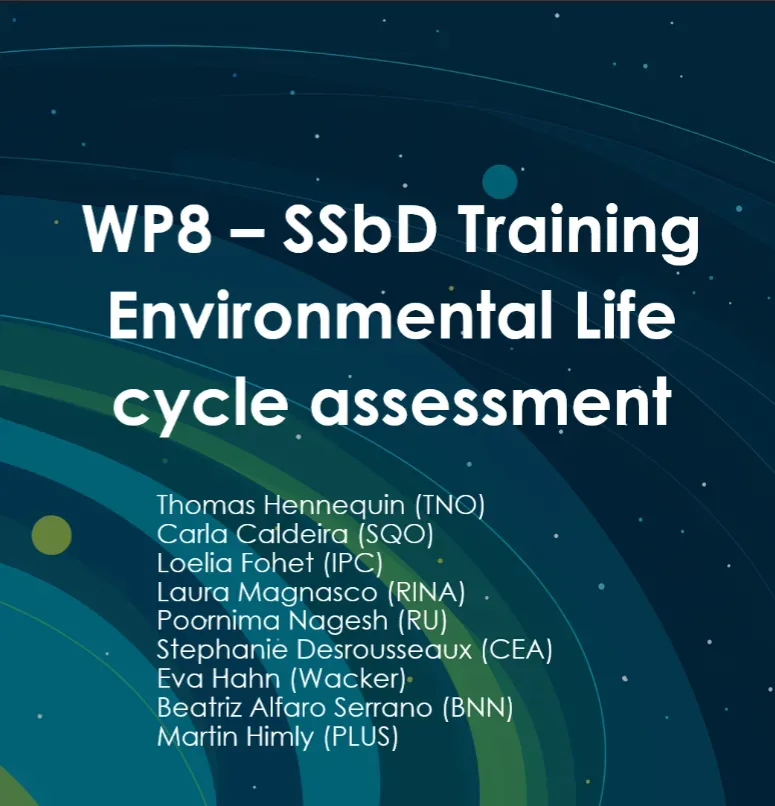
PLANETS SSbD Training in Environmental Life Cycle Assessment (04.11.2025, online)
On 5 November 2025, the PLANETS consortium organised an internal training session on Environmental Life Cycle Assessment (eLCA). The session began with an introduction to the topic and went on to explain the different phases of eLCA in detail, starting with Goal & Scoping. Participants learned about different databases and their particularities, how to apply prospective LCA to earlier stages of innovation, and how to generate endpoints and midpoints from elementary flows. We also briefly discussed how different characterisation factors influence impact assessment, and learnt how to address uncertainty using sensitivity analysis. Participants performed an interactive exercise on building an inventory (LCI) on a specific example of paints.
Highlights of the workshop
The session was moderated by Martin Himly (PLUS), the leader of the training work package within PLANETS. He introduced the session by outlining its objectives, structure and background information. Thomas Henniquin (TNO) explained the four main phases of an eLCA, delving into each one: Goal & Scope, Life Cycle Inventory (LCI), Life Cycle Impact Assessment (LCIA), and Interpretation. The participants performed an interactive exercise on a specific example of paints for inventory (LCI) building, divided into break-out groups.
Thomas provided further insight into databases, multifunctionality and prospective LCA. Loelia Fohet (IPC) then introduced the concept of LCIA, including characterisation factors (CF), and led the attendees in a discussion about interpreting results as part of an interactive poll to gain experience in interpreting results. The final part of the training focused on dealing with uncertainty using sensitivity analysis, which is relevant for interpreting results.
Following PLANETS partners were involved in the preparation of this training: Thomas Hennequin (TNO), Carla Caldeira (SQO), Loelia Fohet (IPC), Laura Magnasco (RINA), Poornima Nagesh (RU), Stephanie Desrousseaux (CEA), Eva Hahn (Wacker), Beatriz Alfaro Serrano (BNN), and Martin Himly (PLUS) .
Training Materials – In preparation
Building on the insights from this internal training, PLANETS has developed external training materials as an introduction to eLCA. These materials include:
- Presentation slides
- A pdf of the collaborative whiteboard of an exercise on inventory building
- Recording of the training. Additionally, recording of one of the break-out rooms (led by Laura Magnasco, RINA)
All training materials are available in the PLANETS community on Zenodo under the Creative Commons Attribution 4.0 International licence, allowing for redistribution and reuse with proper credit to the creators. You can access them here, with DOI: 10.5281/zenodo.19472916.
Additionally, all recorded sessions can be viewed on the PLANETS YouTube channel.

October 22, 2025
PLANETS SSbD Training on Life Cycle Sustainability Assessment (10.09.2025, online)
On 10 September 2025, PLANETS consortium organised an internal training on Life Cycle Sustainability Assessment, with an introduction to the topic and theoretical background, with the main aim of harmonising the consortium’s understanding on this topic, particularly among innovators and industrial partners who are not directly involved in the project.
Highlights of the workshop
The session was moderated by Martin Himly (PLUS), who leads the training work package within PLANETS. He introduced the session, outlining the objectives and structure of the training, as well as background information.
Carla Caldeira (SYENSQO) introduced to SSbD and Life Cycle thinking. Loelia Fohet (IPC) and Thomas Hennequin (TNO) talked about environmental dimension (E-LCA). Laura Magnasco (RINA) was in charge of the Life Cycle Cost (LCC) and the social LCA (S-LCA). Finally, Eva Hahn (WACKER) talked about making decisions with LCA results.
During the break-out sessions, an interactive whiteboard exercise (prepared by Beatriz Alfaro (BNN)) was performed with the participants, to practice on functional units and reference flows.
An interactive poll was also performed with the participants, to get some insight into their level of experience with LCA and the challenges they encountered so far.
Training Materials
Building on the insights from this internal training, PLANETS has developed external training materials as an introduction to LCA. These materials include:
- Presentation slides, with an LCA introduction giving also insight into life cycle cost (LCC) and social LCA
- A pdf of the collaborative white board used during the break-outs where process flows, functional unit and reference flows were determined
- Recording [YouTube video]
All training materials are available in the PLANETS community on Zenodo under the Creative Commons Attribution 4.0 International licence, allowing for redistribution and reuse with proper credit to the creators. You can access them here, with DOI: 10.5281/zenodo.17399294.
Additionally, all recorded sessions can be viewed on the PLANETS YouTube channel.
September 2, 2025
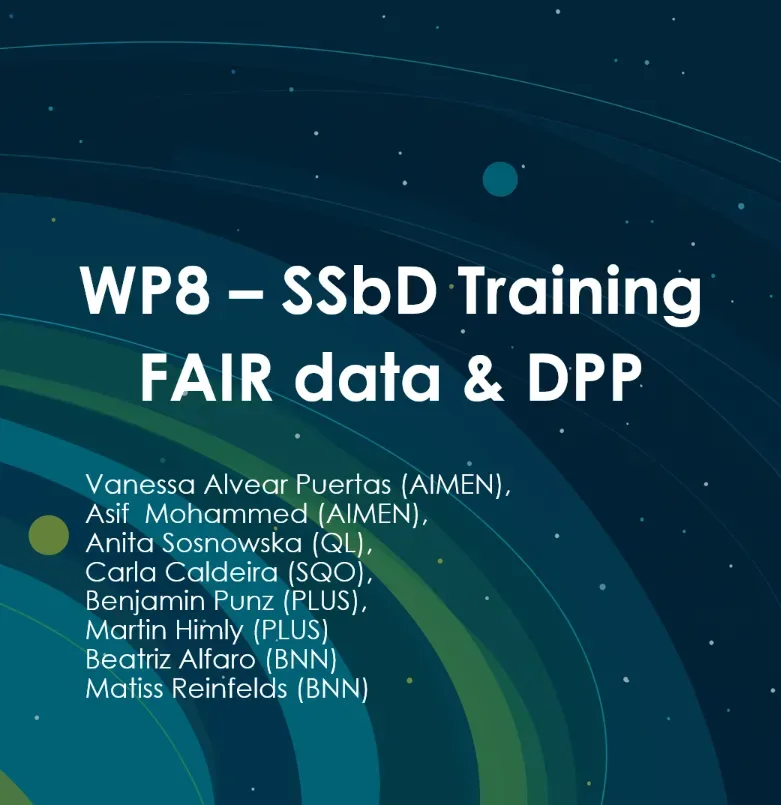
PLANETS 4th SSbD Training on FAIR data & models and DPP (19.05.2025, online)
On 19 May 2025, PLANETS consortium organised an internal training on (1) FAR data & models, and (2) Digital Product Passport (DPP).
Aim and key topics of the training
FAIR data and models: The workshop provided a comprehensive overview of the FAIR data principles—Findable, Accessible, Interoperable, and Reusable—and their application in research data management. It aimed to raise awareness, provide assessment tools, and offer practical guidance for enhancing data FAIRness in research workflows.
- Introduction to FAIR Principles: Participants were introduced to the concept of FAIR, including what the acronym stands for and why these principles are important in data sharing and reuse. The distinction between FAIR data and Open Data was also clarified.
- Assessing FAIRness, exploring common challenges associated with non-FAIR data and introduced tools such as FAIR-Aware and the FAIR Evaluation Services to help participants assess the FAIRness of their own datasets. Real-life examples from other projects (FIPs – FAIR Implementation Profiles) were used to illustrate how organizations are implementing FAIR principles in practice.
- FAIR in Practice, with practical implementation strategies, covering essential elements such as metadata standards, persistent identifiers, licensing and access considerations, controlled vocabularies, trusted data repositories, and approaches to improving metadata quality.
- Internal discussion on FAIR Data and the PLANETS Project, which included a proposed data workflow tailored for the PLANETS project.
Digital Product Passport (DPP): This workshop gave an overview of the DPP concept, its relevance in supporting sustainable and circular product systems, gave policy context, and practical implications for stakeholders across the product lifecycle, preparing participants to understand and deal with upcoming regulatory and data management requirements. Key topics covered:
- Introduction to DPP, with a definition of the Digital Product Passport, and explanation of its role in enabling better product information exchange to support sustainability, compliance, and circular economy goals, including historical and policy background of the DPP and major milestones in its development. The discussion highlighted how the DPP emerged from broader EU policy efforts.
- Policy Context: DPP within the framework of key European Union initiatives EU Green Deal (aiming for climate neutrality), CEAP (Circular Economy Action Plan, promoting sustainable product lifecycles), and ESPR (Ecodesign for Sustainable Products Regulation, which provides the legal basis for DPP implementation).
- DPP Objectives (transparency, circularity, and traceability) and identified key stakeholders involved, including manufacturers, regulators, consumers, recyclers, and others throughout the product value chain.
- Product groups covered by DPP as well as prioritization criteria.
- Data requirements for DPP (such as material composition, carbon footprint, and regulatory compliance information) as well as challenges in data collection and management.
- Practical examples of DPPs in use or in development, to help participants visualize how these passports might be applied in different sectors.
Highlights of the workshop
The session was moderated by Martin Himly (PLUS), who leads the training work package within PLANETS. He introduced the session, outlining the objectives and structure of the training.
Vanessa Alvear (AIMEN) lead the FAIR data training, supported by Benjamin Punz (PLUS). Anita Sosnowska (QSAR Lab) explained the role of QSAR in respect to FAIR and Carla Caldeira (SYENSQO) commented on data sharing versus confidentiality. The DPP training started with an interactive questionnaire (prepared by Beatriz Alfaro and Matiss Reinfelds (BNN) to get the first impressions from the participants about their concerns, potentials and limitations of DPP. The DPP training was led by Asif Mohammen (AIMEN).
Training Materials
Building on the insights from this internal training, PLANETS has developed external training materials as an introduction to FAIR data & models and Digital Product Passport (DPP). These materials include:
- Presentation slides of the FAIR data & models training
- Presentation slides of the DPP training
- Recording of the FAIR data & models training [YouTube video]
- Recording of the DPP training [YouTube video]
All training materials are available in the PLANETS community on Zenodo under the Creative Commons Attribution 4.0 International licence, allowing for redistribution and reuse with proper credit to the creators. You can access them here.
Additionally, all recorded sessions can be viewed on the PLANETS YouTube channel.
September 2, 2025
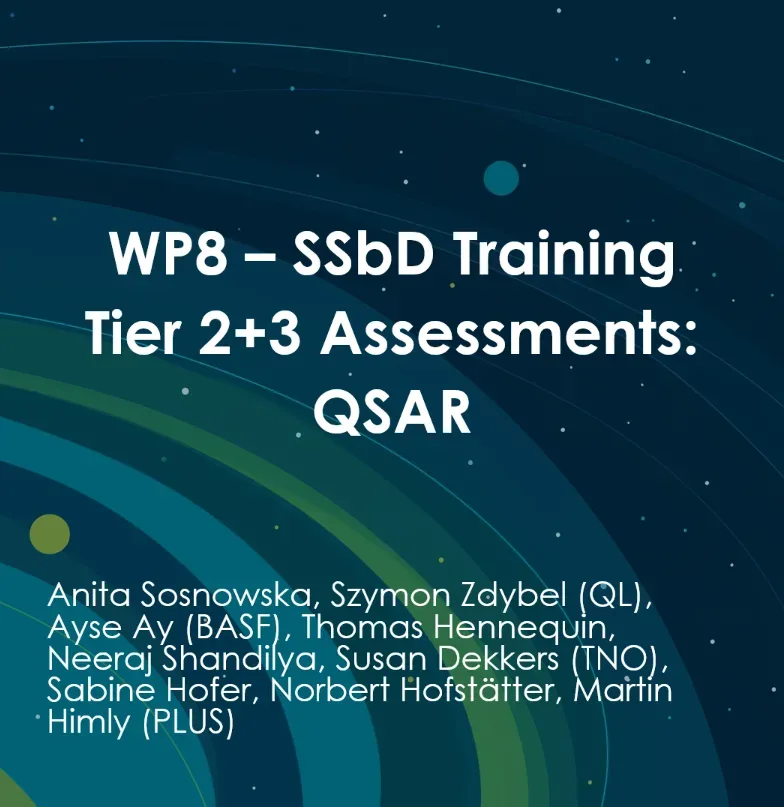
PLANETS 3rd SSbD Training on Tier 2 Assessment-QSAR (08.04.2025, Gdansk, PL, & online)
On 8 April 2025 and aligned with the M6 General Assembly of the project in Gdansk (Poland), PLANETS organized a hybrid internal training for all project partners on SSbD assessment.
The aim of this workshop was the harmonisation of understanding for entire consortium, focusing on intermediate and full assessment (Tier 2-3), including hazard identification, QSAR modelling, and toxicity prediction. Participants explored existing tools for predicting physicochemical properties and biological activities of chemical substances, key elements in the Safe-and-Sustainable-by-Design (SSbD) approach.
Highlights of the workshop
The session started with a brief overview of Martin Himly (PLUS), who leads the training work package within PLANETS, about the previous internal SSbD trainings. He introduced the session, outlining the objectives and structure of the training. Thomas Hennequin (TNO) and Ayse Ay (BASF) continued with a summary of ideas for the collection of harmonised data. Afterwards, Anita Sosnowska (QSAR Lab) gave an overview on QSAR and Szymon Zdybel (QSAR Lab) performed a hands-on exercise on QSAR with all participants.
Training Materials
Building on the insights from this internal training, PLANETS has developed external training materials for conducting a SSbD Tier 2 assessment by QSAR modeling. These materials include:
- A QSAR step-by-step guide, the presentation slides, and four VEGA reports to conduct a practical exercise. Materials available here.
- Recording of the workshop [YouTube]
All training materials are available in the PLANETS community on Zenodo under the Creative Commons Attribution 4.0 International licence, allowing for redistribution and reuse with proper credit to the creators. You can access them here.
Additionally, all recorded sessions can be viewed on the PLANETS YouTube channel.

May 5, 2025
PLANETS SSbD Training on Tier 1 Assessment (20.03.2025, Erpfendorf & hybrid)
On 20 March 2025 took place an internal training for PLANETS WP4 partners on Safe-and-Sustainable-by-Design (SSbD) and Tier 1 assessments, aligned with a project internal Flame Retardant (FR) case study Workshop, in the headquarters of Steinbacher in Erpfendorf (Austria) in hybrid mode.
The aim of the training was to align the knowledge of project partners in the theory and purpose of SSbD Tier 1 assessment, its application as well as discuss about potential further adaptations needed in the SSbD workflow for the project’s case studies. On the basis of the jointly performed Tier 1 assessments onsite gap analyses were conducted and potential further adaptations prioritized for sector- or value chain position-specific requirements.
The session was prepared by Neeraj Shandilya and Thomas Hennequin (TNO), with the support of Joséphine Steck (CEA), Martin Himly, Sabine Hofer, Norbert Hofstätter (PLUS).
Training Materials
Building on the insights from this internal training, PLANETS has developed external training materials for conducting SSbD Tier 1 assessment following the PLANETS SSbD Workflow. These materials include:
- Workshop presentation slides
- Recording of the workshop [YouTube video]
- Questionnaire with guiding questions within the PLANETS SSbD workflow for conduct of the Tier 1 SSbD assessment
All training materials are available in the PLANETS community on Zenodo under the Creative Commons Attribution 4.0 International licence, allowing for redistribution and reuse with proper credit to the creators. You can access them here.
Additionally, all recorded sessions can be viewed on the PLANETS YouTube channel.


April 3, 2025
PLANETS 1st SSbD Training on Scoping (05.03.2025)
On 5 March 2025, PLANETS consortium organised their first internal online training session on PLANETS’ Safe and Sustainable by Design (SSbD) workflow, with a primary focus on scoping. The training aimed to harmonize the consortium’s understanding of SSbD, particularly among innovators and industrial partners who are not directly involved in the project.
Training Highlights
The session was moderated by Martin Himly (PLUS), who leads the training work package within PLANETS. He introduced the session, outlining the objectives and structure of the training. Carla Caldeira (SYENSQO) then provided an insightful explanation of the policy background and fundamental principles of SSbD. Following this, Sabine Hofer and Norbert Hofstätter (PLUS) elaborated on the key actions involved in the scoping process. Joséphine Steck (CEA), the project coordinator, presented the PLANETS SSbD workflow in detail. To enhance practical understanding, a case study on plasticizers in seals (gaskets) was introduced by Martin Himly, serving as the foundation for the hands-on scoping exercise. Participants were divided into breakout groups to practice scoping actions, reinforcing the theoretical knowledge gained during the session.
Training Materials
Building on the insights from this internal training, PLANETS has developed external training materials to facilitate SSbD scoping following the PLANETS SSbD workflow. These materials include:
- Recording on policy background and SSbD basics [YouTube video]
- Recording on scoping actions [YouTube video]
- Recording introducing the PLANETS SSbD workflow, along with a practical exercise using the JRC gasket plasticiser case from the SSbD stakeholder engagement phase [YouTube video]
- Workshop presentation slides
- Case description detailing the JRC gasket plasticiser background
- Guiding questions and practical exercise worksheet listing potential solutions within the PLANETS SSbD workflow
All training materials are available in the PLANETS community on Zenodo under the Creative Commons Attribution 4.0 International licence, allowing for redistribution and reuse with proper credit to the creators. You can access them here.
Additionally, all recorded sessions can be viewed on the PLANETS YouTube channel.
A special thanks to Joséphine Steck (CEA), Carla Caldeira (SQO), Beatriz Alfaro (BNN), Norbert Hofstätter, Sabine Hofer, and Martin Himly (PLUS) for their valuable contributions to making this training a success!
