PLANETS SSbD Training on Life Cycle Cost assessment (LCC) (12.12.2025, online)
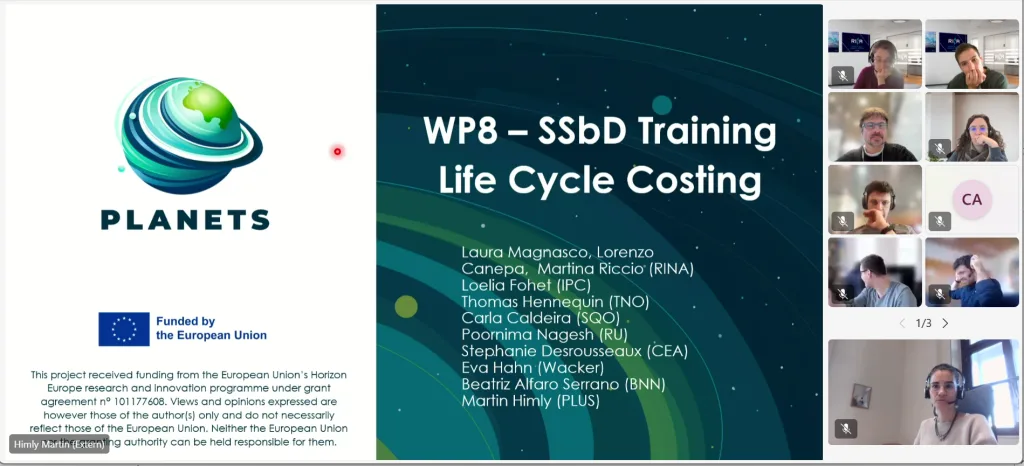
On 12 December 2025, the PLANETS consortium organised an internal training session on Life Cycle Cost assessment (LCC). The session began with an introduction to the topic, followed by an explanation of the different phases of an LCC: Goal and Scope, Inventory, Impact Assessment and Interpretation. Participants learnt how to evaluate and visualise LCC results, and gained insight into the pros and cons of including this economic dimension in SSbD assessments. The discussion also covered Critical Raw Materials (CRMs) and their relevance for SSbD assessments. Participants then performed an interactive exercise on building a cost inventory using paints as a specific example.
Highlights of the workshop
Martin Himly (PLUS), the leader of the training work package within PLANETS, started the training. He began by introducing the session and outlining its objectives, structure and background information.
Loélia Fohet (ICT) then explained the importance of including the economic dimension in SSbD assessments. This economic dimension includes LCC (identifying cost hotspots) and identifying Critical Raw Materials (CRMs) (evaluating risks in the value chain). She also emphasised that a correct SSbD assessment requires consideration of all three sustainability dimensions: environmental, economic and social. Loélia then clarified what an LCC is, emphasising that it is an assessment method, not an economic cost-accounting method, related to the product under consideration.
After a short interactive Mentimeter session to evaluate the participants’ level of knowledge of LCC, Lorenzo Canepa (RINA) provided a detailed overview of the LCC steps (goal & scope, life cycle inventory, impact assessment and interpretation of results), with a focus on the stakeholders’ perspective in goal & scope. Laura Magnasco (RINA) explained life cycle inventory (LCI) data needs, the differences between LCC and LCA inventories, and provided tips on addressing missing inventory data at low TRL (e.g. CAPEX, maintenance costs, and personnel costs).
Participants then split into different breakout groups, moderated by Laura Magnasco, Lorenzo Canepa (RINA), Loélia Fohet (IPC) and Thomas Hennequin (TNO), and had the chance to build a cost inventory using a specific example relating to paints.
Finally, the pros and cons of including the economic dimension in SSbD assessments were analysed.
In the final part of the training, Laura Magnasco (RINA) discussed critical raw materials (CRM), explaining what they are, why they are important, how to evaluate them, and why they should be evaluated in SSbD assessments.
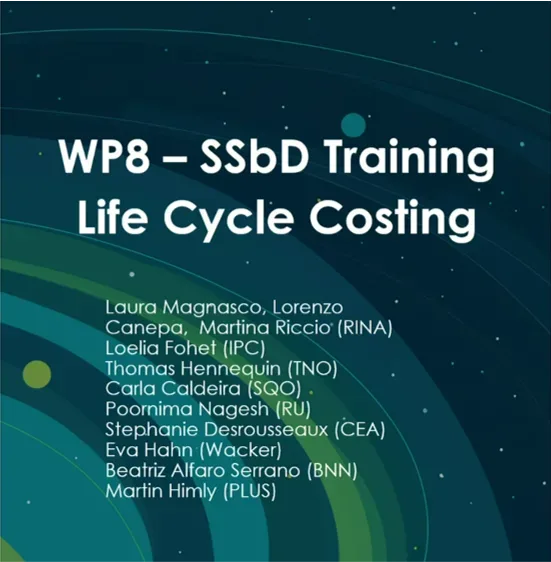
The following PLANETS partners were involved in the preparation of this training: Laura Magnasco, Lorenzo Canepa, Martina Riccio (RINA), Loélia Fohet (IPC), Thomas Hennequin (TNO), Carla Caldeira (SQO), Poornima Nagesh (RU), Stéphanie Desrousseaux (CEA), Eva Hahn (Wacker), Beatriz Alfaro Serrano (BNN), and Martin Himly (PLUS).
Training Materials – In preparation
Building on the insights from this internal training, PLANETS has developed external training materials as an introduction to LCC. These materials include:
- Presentation slides
- A PDF of the collaborative whiteboard for a cost inventory building exercise
- Recording of the session, including the break out rooms [LINK TO YOUTUBE VIDEO to be added]
All training materials are available in the PLANETS community on Zenodo under a Creative Commons Attribution 4.0 International licence, which allows for redistribution and reuse with proper credit to the creators. You can access them here (ADD LINK), with DOI: xxx (tba).
Additionally, all recorded sessions can be viewed on the PLANETS YouTube channel.