
Case Study: Developing Safer and more
Sustainable plasticizers
WP5 – IPC, main SSbD partner – IPC
What are plasticizers?
The name “plasticizer” originates from the Greek word “plastikos” (πλαστικός), meaning “fit for molding.” Many materials in their original form are brittle, but when a plasticizer is added, they become more pliable and workable. Think of flour, which, when mixed with a suitable plasticizer—water—turns into dough. Similarly, synthetic materials, such as polyvinyl chloride (PVC), are naturally hard and brittle but become softer and more flexible (like a vinyl record) when a plasticizer is introduced.


Current State in the Chemical Industry
There is no universal plasticizer, as each material has its own chemical structure and therefore needs to be matched with specific chemical properties from a given plasticizer. This creates a large and diverse market for plasticizers.
A persistent challenge is the migration of plasticizers (leaching), as they are often relatively small molecules that can escape from the polymer structure—similar to how water evaporates from dough.
Unlike water, not all plasticizers are harmless. For example, diethylhexyl phthalate (DEHP), once widely used, has been restricted in the EU due to its endocrine-disrupting properties.
Despite such concerns, soft plastics remain in high demand. For instance, childcare products such as baby spoons require lightweight, durable materials with smooth surfaces and no sharp edges—properties that are difficult to achieve without plasticizers.
PLANETS’ Safe-and-Sustainable-by-Design Solution
PLANETS will address this challenge from two sides. One approach focuses on silicone, a material capable of providing the desired properties without the need for plasticizers. However, silicone itself can contain unwanted impurities that may remain in the final product posing danger to the health of the user, and the manufacturing process of raw silicone materials can result in emissions of other harmful substances into the environment. Furthermore, most silicone is sourced from outside the EU, complicating efforts to ensure transparency and traceability across the value chain.
Addressing these uncertainties is essential to achieving truly Safe-and-Sustainable-by-Design (SSbD) silicone products, which in this case study would be a teether.
To accomplish this, ELKEM, a leading manufacturer of silicone raw materials, will join forces with IPC and STERNE in their roles as product designers, manufacturers, and recyclers, working collaboratively with SSbD experts from PLANETS.
The second part of this case study focuses on producing a baby spoon made from thermoplastic elastomers containing SSbD plasticizers. While alternative plasticizers are already available on the market, further toxicity testing is required to address remaining safety concerns.
ELKEM, IPC, and STERNE will collaborate with SSbD experts from PLANETS to close these gaps and ensure the safety and sustainability of the materials used.
Plasticizers Case Study – Progress & Next Steps
During the first 18 months of the PLANETS project, progress was made on several tasks aimed at developing safer and more sustainable alternatives to plasticizers: a Tier 1 assessment was carried out on several alternatives for silicone and TPE materials. After definition of routes, development of RUN1 alternatives was carried out with the most promising formulation using soft materials silicone and TPE free from CMR substances and sourced from the European value chain, socially acceptable and economically comparable to the benchmark.
- M8 (June 2025): Tier 1 assessment on both silicone and TPE carried out.
- M18 (April 2026): Results of the social acceptance study on childcare products are collected.
- M18 (April 2026): Initial food contact alternatives free from plasticizers produced.
What’s coming next?
- M19 (May 2026): Collection of end-of life soft plastic products to use for RUN 2 recycled alternatives.
- M22 (September 2026): optimization of the silicone and TPE formulation of RUN 1 alternatives.
- End of 2026: Full SSbD Tier 2 assessments completed on RUN 1 alternative.
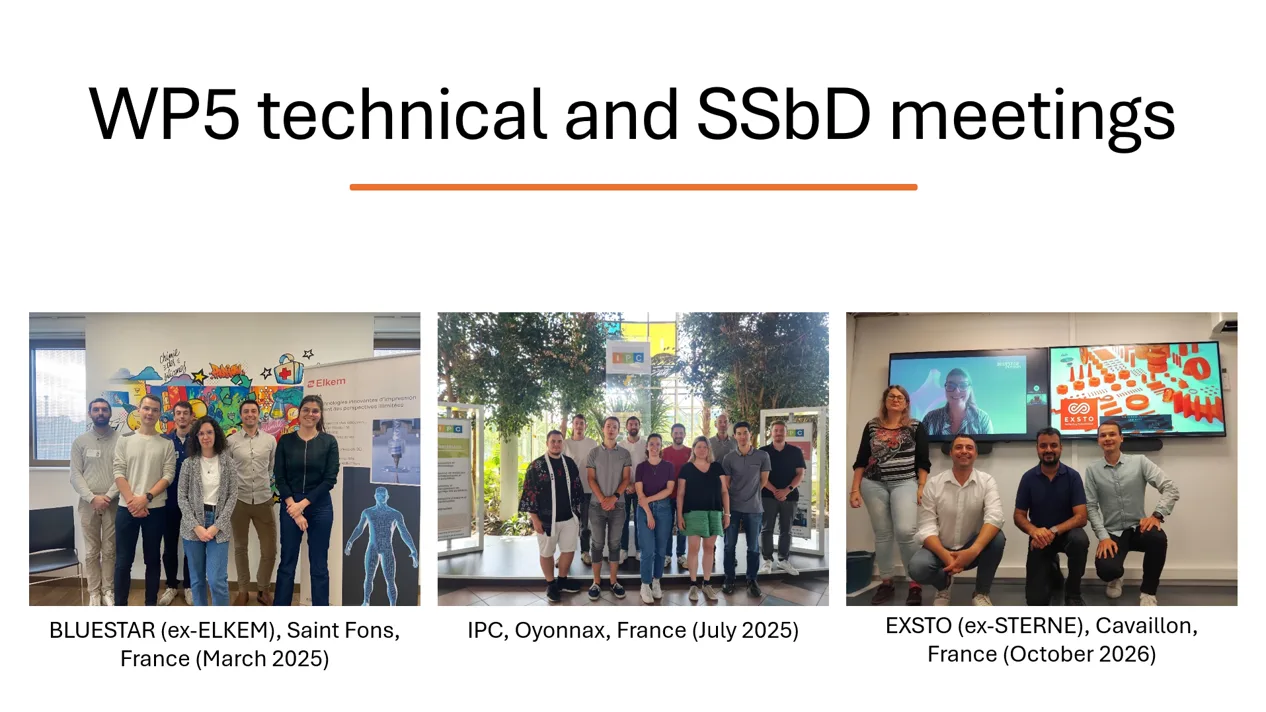
Onsite WP5 technical and SSbD meetings – Highlights of the (internal) collaboration within the Plasicizers Case Study.